
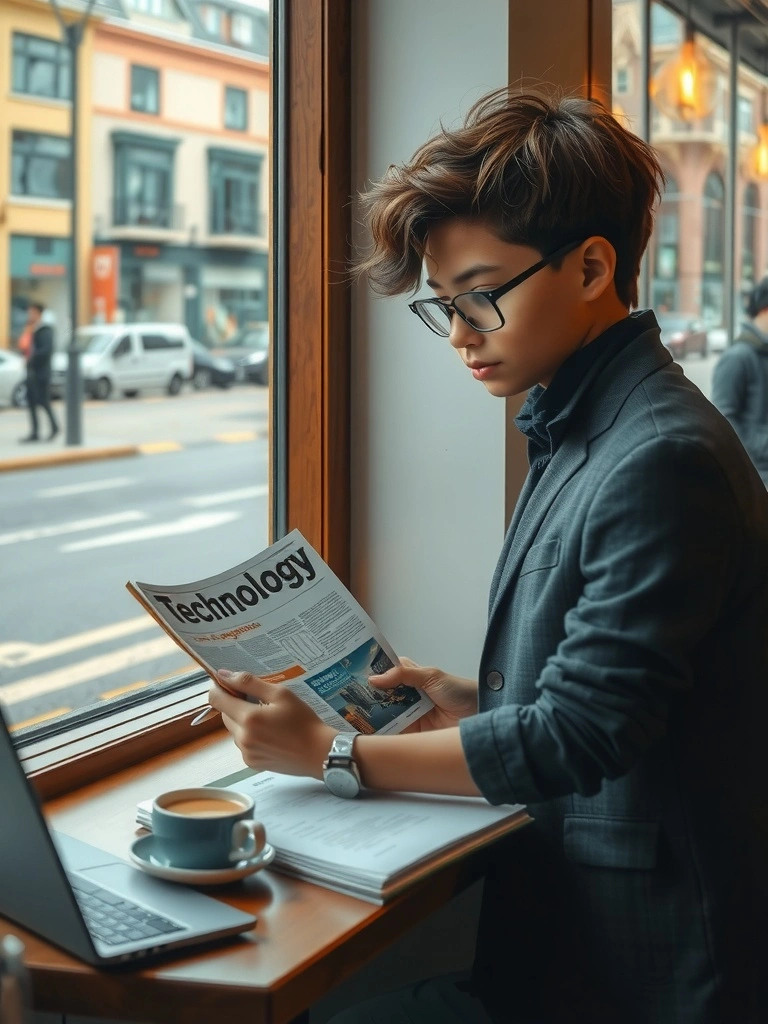
In the afternoon, a café in the city center welcomes a wave of tranquility. Sunlight pours in through the floor-to-ceiling windows, and in a corner by the window sits a young man, dressed in a uniquely styled literary shirt, a gray-blue knitted jacket draped lightly over his shoulder, and retro jeans paired with handmade canvas shoes. This figure by the window creates a portrait of modern urban aesthetics. He is focused on reading a technology magazine, occasionally looking up to observe the bustling traffic outside, then lowering his head again to concentrate on his notebook, writing down his thoughts with a fine pen. Next to him rests a silver laptop, its lid slightly ajar, the screen displaying an unfinished manuscript and some web pages, while the aroma of a steaming latte fills the air.
The café itself is a sight to behold, with walls adorned with works from local illustrators and photographers, wooden tables and chairs, and deep green plants decorating the space. Whether for hurried office workers or relaxed students, everyone can find a moment of peace and comfort here. The young man has become the focal point of this everyday scene. His table is neatly organized: a stack of sticky notes arranged neatly, two pens of varying thickness resting quietly in a corner of the magazine, and a notebook with a milky-white feather bookmark that exudes an artistic vibe. His phone is temporarily placed on the left side of the laptop, not lit up; in this moment, he has detached himself from the digital flow, focusing on physical reading and the act of handwriting.
Looking closely at the magazine he is reading, the bold headline on the cover predicts that artificial intelligence is set to disrupt the new normal of life. His eyes glide from one feature article to another, introducing various tech startups. He occasionally jots down keywords, sometimes noting an interesting statistic, while at other times sketching charts for analysis, his handwriting neat and fluid. After completing a note, he looks up to gaze at the modern urban landscape outside the window—the bustling pedestrians, the flowing vehicles, and the endless bike lanes—all weaving together the infinite vitality and creativity of the city.
The way this young man engages in reading and thinking encapsulates the essence of many young people today. They are eager to acquire new knowledge, using their phones as tools for collecting information while also valuing the weightiness and focus that printed magazines provide. For them, handwriting notes is not just about record-keeping; it is a ritual of self-dialogue. He has not entirely abandoned digital tools; even though the laptop on the table isn’t constantly in use, it subtly reveals how the "digital natives" blend modern technology with traditional learning methods in their daily choices.
When the magazine turns to a column discussing smart cities, he lingers there for a while. The accompanying image speculates on future transportation, and the article mentions self-driving vehicles, smart streetlights, urban air conditioning systems that can adjust temperatures in real-time, and creative ideas for embedding environmental sensors into sidewalks. On his notebook, he adds two handwritten notes: “Smart cities should be people-centered; technology should serve to enhance quality of life” and “How to avoid digital disparity caused by technological advancement?” After pondering for a long while, he flips the page, seemingly mulling over the answers to these questions in his mind. Occasionally, when inspiration strikes, he will tap on his laptop to search for relevant papers or recent news articles, comparing different experts' views and supplementing his insights in the empty spaces of his notes.
In his coffee time, this cycle repeats itself. Occasionally, a café staff member softly inquires whether he needs a refill, and he politely shakes his head, thanks them, and focuses again on his immediate world. Sometimes, a young couple passes by, whispering and sharing amusing videos on their phones; occasionally, someone walks by with a large dog, bringing a brief smile to his face. But for him, the most important thing at that moment is immersing himself in the learning experience at the intersection of technology and reality.
This scene reflects how many modern urban dwellers' learning habits are quietly transforming. No longer is it just about fast information acquisition or fragmented reading; more and more people are beginning to return to the idea of "focus." Breaking away from the immediate notifications of their phones, shifting from multitasking back to “one task at a time,” they choose to create a pure space for learning and contemplation, aided by emerging technologies in a suitable atmosphere.
Professional observations indicate that this “half-digital, half-printed” new lifestyle helps the younger generation think deeply and cultivate logic, thus internalizing the information they engage with into their own knowledge. Research shows that handwritten notes stimulate memory and comprehension more than merely typing on a keyboard. The young man present exemplifies this directly: while flipping through the latest technological developments, he deconstructs and digests complex information, marking hard-to-understand sections clearly for later verification and elaboration. This is not just learning; it is a process of dialogue with the world—magazine content, online verification, and street scene observations naturally blend in his mind, keeping his pace and thoughts at the forefront of the times.
Outside, the daylight gradually fades, the city’s neon lights begin to illuminate, and the streets fill with the youthful faces of students and the footsteps of white-collar workers after work. Just like any other day, this café slowly transitions from a busy peak to an elegant evening calm. The young literary man closes the magazine, carefully seals up his notebook, leaving just a sip of coffee in his cup. As he stands up, he still remembers to neatly gather all his belongings, gently push the chair back to its original position, and nod and smile at the counter. This brief pause and focus culminate in a serene and profound spiritual journey during this urban afternoon.
This lifestyle of navigating between paper and digital, immersing in knowledge and reality, has become the daily scenery for an increasing number of modern urban youths. With a technology magazine in hand, delicate notes in writing, a silver laptop serving as both a database and a creative space, and the view outside no longer just a scene but an extension of thought, every focused young individual like him is chasing their own rhythm of an ideal life, quietly carving out distinct trajectories in the vast sea of information and contributing to the city with a blend of rationality and poetic reading landscapes.